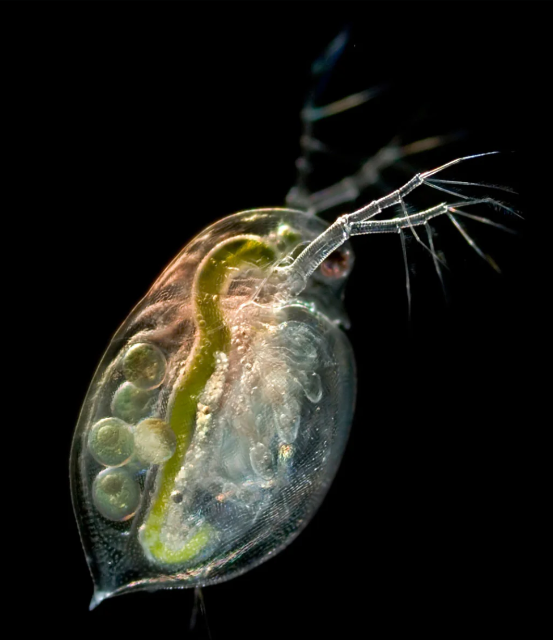
A computational study investigating whether collective Daphnia deviate from random turning behavior using differential modeling and vector analysis.
High-fidelity recording of Daphnia in 15cm petri dishes. Processed using TRex to extract coordinate data.
Python models used to quantify displacement and trajectory paths from raw .pv files.
Implemented MATLAB algorithms to compute "Cumulative Angle" (φ) via velocity vectors:
By analyzing the cumulative angle plots across 50+ trials, we identified a distinct behavioral divergence between isolated individuals and groups.
Single Daphnia showed no discernible trend. Behavior was randomized and unstructured, consistent with Brownian-like motion.
Groups exhibited consistent rotational bias (Clockwise/CCW). This "handedness" emerged dynamically from group interaction, not hardwired biology.
The research group is currently expanding on my foundational work by introducing a Multi-Axis Behavior Rig to map 3D dynamics (X-Z plane). We are also utilizing SLEAP.AI for morphometric pose estimation to determine if physical body asymmetry drives the observed rotational bias.
Contains tracking scripts, vector analysis notebooks, and data tracking logs.
PDF Preview optimized for Desktop.
Download to ViewD. Young, A. Lin, S. Alvarado, O. Kogan. "Collective Behavior of Daphnia." CUNY Queens College, 2024. Reproduced with permission of all co-authors.